Showing posts with label 1989. Show all posts

Wednesday, July 22, 2026

Saying goodbye ~ July 20, 1989

David Heiller

The small black suitcase lay before me on the bed, and I hesitated before opening it. The suitcase stays in the top dresser drawer in my old bedroom, but I had never opened it before. And now, I hesitated just a second before lifting the two metal clasps, like you hesitate before lifting the phone receiver to call a friend you haven’t seen in a long, long time, not knowing who’ll answer.
Inside the black vinyl case, two bright scarves lay on top, and two hand-made pot holders, and a ceramic wall hanging, carefully painted but with colors running into each other, the yellow banana flowing onto the green foliage. Some construction paper posters were carefully folded, along with two hot pads, and a Girl Scout sash with 16 merit badges from Troop 93, Peace Pipe Council.
David and Lynette with Grandma Schnick.
I touched these things carefully, seeing for what seemed like the first time in 20 years, the smiling girl who had made them and worn them, my sister, Lynette.
Letters filled the rest of the suitcase, some still in envelopes with four cent stamps, some lying loose, scrawled in pencil. I hadn’t seen that writing for so long, the careful printing that didn’t quite stay on the line, like the ceramic colors that didn’t quite stay on their mark. I could see the toes as they gripped the stubby pencil so tightly, see the short strokes stab the paper slowly, carefully.
You know these pink slacks you made me, well their too baggy, Lynette wrote on April 29, 1968. Why can’t I get a dress for Kathy’s wedding? Everyone else is.
In a letter from Worthington Crippled Children’s School on February 20, 1966, Lynette told Mom: I will send you a copy of the paper we wrote. Boy, will you be surprised what I wrote. I miss you all, even Glenn and Sharon (the cats too).
A letter from the University’ of Minnesota Hospital on March 16, 1965, said to Mom: I hope I can go home Friday. Will you make Kathy come with you. I wanta see so bad, and she is my best sister (don’t let the girls read this or they’ll be mad at me). Glenn came Saturday night. Love to all, Lynette.
David and Lyn at Christmas
A letter from Kathy that same year lay next to this letter. I hope now that you are feeling better and can get around more, Kathy wrote. After an operation, no one feels like doing anything. Boy I bet you sure had fun when you were home, didn’t you? I suppose everyone was so glad to see you.
There was a letter from Mary Ellen to Lynette at the hospital, with a card and a kiss drawn in red taped to the page. I’ll send you a piece of gum, Mary wrote. I hope they let you chew it. I know how you love it!
There was a check-off list of things to take to Camp Courage, where Lynette loved to go every summer. Lynette had crossed “playsuits” off the list and written in “pant dresses,” more befitting to a teenager.
There were letters from Lynette when she was at Camp Courage too. Today is windy, she wrote from camp on June 23, 1964. Janet is always making me laugh. Did you get my radio fixed yet?
Two little autograph books in the suitcase had messages written to Lynette from Camp friends. One message read:
You’ve been a great camper,
Even in the heat.
But I’m still jealous
I can’t write with my feet!
Love, Margaret.
Other messages were more somber. A girl named Mary Beth wrote: You’re really the best roommate a camper could ever hope for. I’m going to miss you when you have to go on your own way and I on mine. I just hope you never forget me.
Grandma Schnick had some practical advice in the autograph book. She wrote: I just can’t think of any verse to write so will just say how very proud I am of the way you are improving and know you will keep right on. Love, Grandma
Finally there was a message from Mom: Lynette: I hope you never forget how to laugh. Love, Mother.
Laughter. Mom knew her daughter better than anyone, and in one sentence had touched Lynette’s shining star, her laughter.
Amidst all the letters was a folded piece of scratch paper. Mom’s familiar handwriting stood out on the clean side:
I knew the time had come to put away
The things you’d never use nor see again.
“Be calm, detached,” I said to me.
“These are but things.” 
But oh, they were so dear, For they had known your touch.
And in your purse I found a little mirror.
Long I gazed into its depth,
Hoping for a reflection of your smile
Captured there.
But all I saw was my own brimming eyes
And I knew the searching was in vain
And you were gone.
I closed the suitcase, just as my mother must have. Cindy lay beside me. I put my head on her chest, and cried, feeling the sheet turn wet beneath my face. I cried like never before, never since July 21, 1969, at Lynette’s funeral, three days after she had drowned at Camp Courage.
It wasn’t that long ago, 20 years, and I haven’t forgotten her, but somehow, I had never said goodbye, until now.


Saturday, June 27, 2026

Some fish never stop growing ~ July 6, 1989

David Heiller

We did a lot of fishing when I was a kid, growing up on the Mississippi River in southeastern Minnesota. I have a thousand memories, but one stands out. It’s so old, I only remember remembering it, if you know what I mean.
It was a summer evening, when I was about six. We were fishing off a dock south of Brownsville, in the backwater. The dock was full of us kids. I had a cane pole, of course, and stood at the edge of the black water, which lapped over the old wooden planks and onto our feet. It was that still time of day, with the warm smell of summer evening in the air, a smell kids know, a mixture of fish and water and wet wood and mayflies and warm sunshine.
I remember that smell, and I remember my cane pole just about jumped out of my hand as a fish took the huge bobber under. I pulled up, the black line straining, and suddenly a huge bass lay thrashing on the dock. It shook out the hook, and started flopping toward the water. Glenn, my older brother, stood and gawked for a split second. Then he pounced on the fish like a cat, and clutched it in 15-year-old hands, a lunker large mouth.
It seemed like a lunker to me, anyway. We measured it at 16 inches on the spot. By the time we got home, it was 18 inches long. That’s all the longer Glenn would allow it to grow, and it has stayed there for 29 years. I admired that black bass for years. I used to hold my hands apart 18 inches, and tell myself, “That’s how long it was.” I could see its green back, the black line running down the side, the huge mouth, the red in its eye. It’s been my favorite fish ever since.
Noah's bass
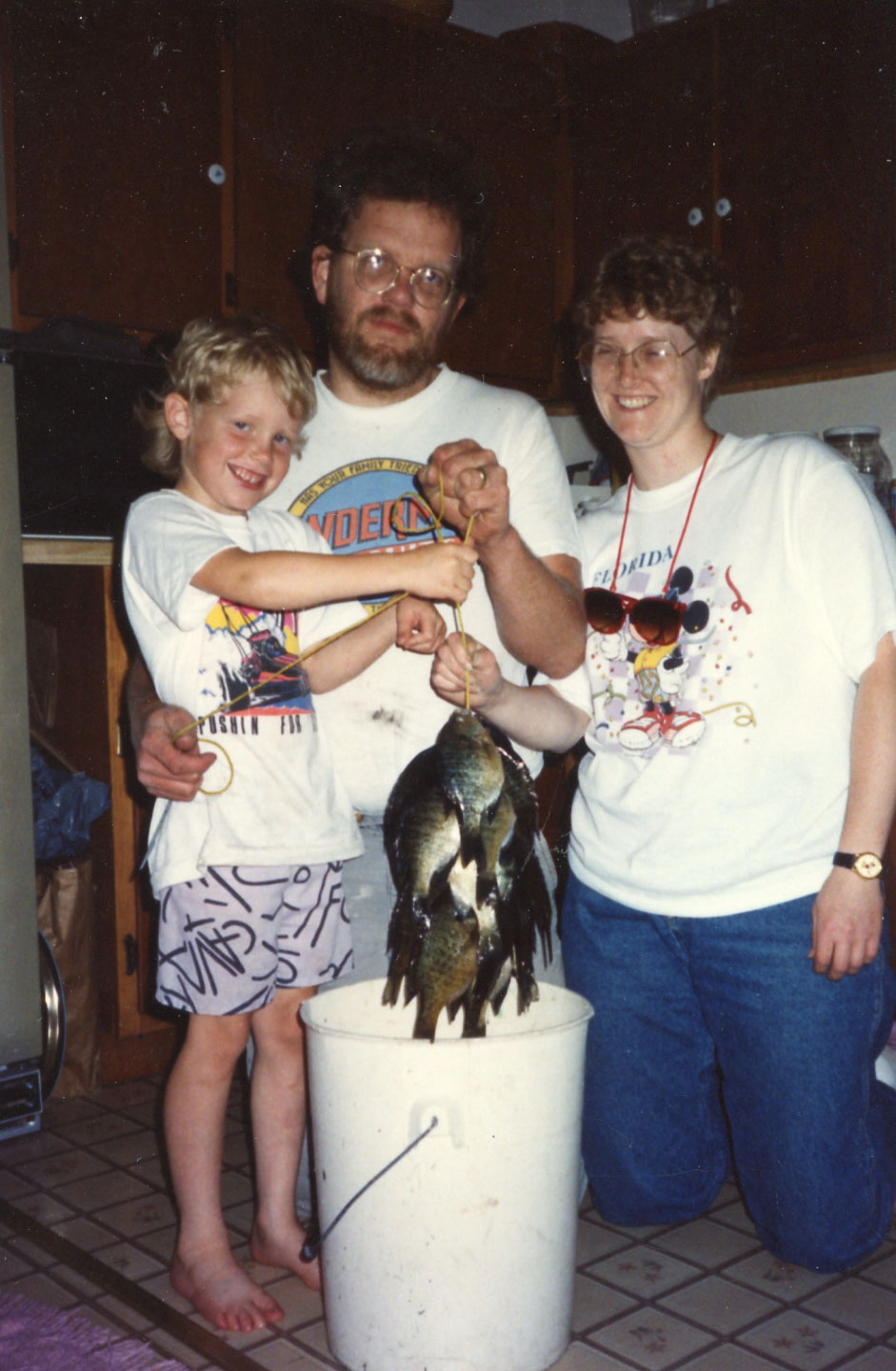
This past weekend, we took a family vacation to a cabin on Pelican Lake, near Orr, Minnesota. As soon as we had unpacked the car, we piled into the boat, and headed for a fishing hole, my son, Noah, my sister-in-law, Nancy, and me.
We pulled up at a narrow channel between two small islands. It looked like a good spot, according to the resort map. “Reef,” it said, showing tiny lines in a circle. Besides, another boat was here too. They must know what they were doing, I thought. That’s a basic rule of fishing: If you don’t know what you’re doing, find someone who looks like they do. One of the guys from their boat was in the water, tugging at the anchor rope. “Anchor’s stuck on the rocks,” he called out as we pulled up 30 feet away.
Noah cast a nightcrawler out from his Mickey Mouse rod and reel, while I bent down to bait my hook. Suddenly there was a splashing. Noah yelled, “I’ve got one, I’ve got one.” His rod, all three feet of it, was doubled over the side of the boat out of sight. It pulled him to his feet.
“Pull it in,” I said, thinking it was a sunny. Then I saw the swirl of a large green back in the water. I gawked for a split second. “Help him, Nancy,” I called. She reached out, grabbed his line, and hoisted the fish into the boat.
“Look at that, Dad,” Noah said. He held up a largemouth bass, about 16 inches in length. It must have weighed a pound and a half, maybe a little more.
Good fishing for Noah, David, and Nancy.
“Nice bass,” the guy in the water called from the nearby boat. It was an honest compliment, but did I detect a touch of jealousy, a wistful tone in his voice? Where had I heard that before? From my brother on the dock south of Brownsville 29 years ago?
The fishing peaked then and there. We caught plenty of sunnies the next two days, plus perch and crappies and smallmouth and rock bass and a two pound northern. But no more largemouth bass like that.
Which was fine with Noah. Because the largemouth began to grow almost as soon as it was filleted and refrigerated. “How big was it, Dad?” he asked that evening as we returned to the hot spot. He held his hands maybe two feet apart. “That big?”
“No, not quite,” I answered, trying not to smile.
“That big?” He moved his hands 18 inches palm-to-palm, but they immediately drifted apart, like opposite poles on a magnet, and the fish grew some more.
“Yeah, I guess so,” I said, smiling.
And for a split second, I smelled it again, that smell of fish and water and wet wood and mayflies and warm sunshine.

Sunday, May 31, 2026

Holy Moley, Mollie ~ April 20, 1989

 
David Heiller

My daughter, Malika, is good friends with Becky Lourey. There’s a 40 year gap in age between them, but they still have established a good friendship.
I like Becky for a lot of reasons that Mollie doesn’t understand. Her convictions, her caring, her enthusiasm, her family commitment, even her organizational skills. How can you not like someone who is so organized that she folds her family’s dirty laundry before washing it?
Mollie doesn’t understand those things, but she does understand a friendly face, moles and all.
Let me explain. It started at the Embassy Bar in Sturgeon Lake last fall. Becky

A mole-less Becky.

had a fundraiser there in preparation for her Minnesota House of Representative race with Doug Carlson. Becky, like a good politician, hugged Mollie, and talked to her. Mollie hugged back. She seemed to feel the energy, the glint in Becky’s eyes. Four-year-olds have a lot of energy, and glinty eyes too. Becky knows how to talk to kids, what with 11 kids of her own to practice on.

And Mollie liked Becky Lourey for another reasonher moles. Mollie touched the one on Becky’s forehead, and the one on her cheek. Becky let her too, and explained what moles are, if anyone really knows what moles are.
I don’t know why Mollie liked the moles so much, but I have a hunch that they were special because they were something she didn’t have, and therefore something she wanted.
Mollie didn’t forget Becky after that. Often when we would drive past the Embassy Bar, she would say, “There’s Becky’s house!”
But Becky showed up at a party three weeks ago with no moles in sight. Mollie took notice, and took offense. Becky explained that the mole on her forehead had swelled up, and started to hurt. Her doctor advised taking it out, along with the one on her cheek and several others farther south. Mollie didn’t buy that. Becky finally took her aside and asked that she be forgiven for taking off the moles. Mollie agreed. Becky asked, “Do you still love me?” and Mollie said yes. She has a kind heart for a four-year-old.
But the next day I wasn’t so sure. As we drove past the Embassy Bar and Mollie made her remark about Becky’s home, I asked her if she’d had a nice visit with Becky.
“She took my moles off, too,” Mollie claimed. “Hurts my cheeks and I got blood.”
“I don’t see blood,” I said.
No, yesterday I went to the doctor,” she insisted. “One day the doctor took off my moles and then threw them in the garbage. I didn’t like them take off.”
“Do you still like Becky?” I asked.
Mollie nodded. “But if she takes any moles off, I won’t like her anymore,” she said.
That answered my question, sort of, and I have since dropped the subject. No point in making a mountain out of a mole hill. But I hope Mollie can overcome her prejudice of the mole-free Becky Lourey. They’ve got too much in common, too much of a budding friendship. Then maybe Mollie can even run for political office, and be an Outstanding Minnesota Woman too.
~drh
The next week we received a hand written note complete with a drawing for Malika. It completes this tale. Becky has had many more losses that are too difficult to bear, as have we. Malika and Becky remained close over the years, Malika considering Becky her mentor. Here is the note from Becky to little Mollie:

~Dear Mollie~
I hear that you miss my moles. I do too! One day last week, I held a little child and when he, reached his hand out toward my face, I thought he was going to touch my mole, and then I remembered that it was not there. My face is not as much fun for children as it used to be
This picture is supposed to be me and I Put the moles on with a sticky paper so you can take them off and put -them on until you are really ready for them to be gone. (Here is where Becky added a lovely self portrait)
I thought that I would tell you a sad story that explains why I feel okay about losing my moles. There, are some things we might not want to lose, but we can stand to lose them. And then there are some things that when we lose them, we miss all of our lives. It is important to remember the difference, so that we can get over losing the things we like but don’t really need.
Once we had a little son who died because his heart wasn’t made right and so it couldn’t work right. Forever and forever I will miss him. And so I know that the moles aren’t as important, and I can let them go.
I bet you can think of things that you would never ever want to lose, and,then think of things that you could get along without if you lost them.
I can stand to lose my moles, but I sure couldn’t, stand to lose your friendship, Mollie.
love, BECKY

Tuesday, April 21, 2026

Remembering a few good teachers ~ April 13, 1989


David Heiller


What makes a good teacher? I found myself asking that question this week, for a couple reasons.
One reason was Rocky Kroon’s letter to the editor, which appears on this page. Rocky doesn’t write letters to the editor every week, or every year. His words are sincere, as he tells about one good teacher, good in the classroom and in the community. Please read it.
The other reason started with an incident last week at Askov Deep Rock. A group of people were standing at the counter, passing time. George Frederiksen told Pat Mee some fire department news.
“You’d better write it down and put it in your pocket,” I joked to Pat. Pat is the kind of guy who has a pocketful of notes to help him remember. His coverall pockets sometimes bulge like a file cabinet, filled with his notes.
“I’ve got a better idea,” Pat said, as he took his pen and wrote his reminder on the back of his hand.
The school and school-yard in Brownsville 
where Mrs. Sauer taught young 
Mr. Heiller the do's and the don't-s.
“Don’t write on your hands,” I said.
“Why not?” Pat asked, looking a little surprised.
I couldn’t answer for a second. Then I remembered Mrs. Sauer. “Because you’re not supposed to. People’s hands aren’t for writing.”
I felt a little embarrassed, telling a man like Pat Mee not to write on his hands. But Mrs. Sauer’s words just came out on their own.
“I had this seventh grade teacher, Mrs. Sauer,” I explained to Pat and George and Maureen Seibert. “She taught us never to write on our hands.” I can still remember her scolding Lynn Rohrer, an eighth grader, for writing on her hands. ‘Your body is a temple. Don’t abuse it,’ Mrs. Sauer had said, or something like that. ‘You weren’t born with ink on your skin, or holding a ball point pen.’
“And she taught us that whenever a woman drops something, a man should always pick it up for her,” I went on, not caring if Pat or George or Maureen really wanted me to. “She used to stand at the front of the class and drop her pen, and all the boys would dive for it to give it to her.”
Maureen looked at me. “She really made an impression on you, didn’t she?” Maureen asked.
“Yeah, she really did,” I answered. Funny, I hadn’t thought of Mrs. Sauer in years, but just like that, on a Tuesday morning some 22 years and 250 miles later, I remembered her. Good teachers will do that, the kind Rocky Kroon writes about.
I could write a book about Mrs. Sauer. She was about 50 then, and had grown-up daughters. We used to joke that one was named Dinah. We wanted to ask what it was like to have a “Dinah Sauer” for a daughter, but we never dared. Mrs. Sauer had sharp features, a hawk-like nose, reddish hair, piercing eyes. She moved quickly, and with complete confidence.
She thought quickly too, and wouldn’t hesitate to tell you things like: ‘Don’t write on your hands.’ And we listened.
One of David's
Brownsville school photos.
Mrs. Sauer would read books to us, a chapter a day from one of her favorites, like Little House on the Prairie. She made us read too, and everybody read, everybody checked out books from the library. Mrs. Sauer inspired us, and I can’t think of one student who didn’t respect her and obey her. She was that once-in-a-lifetime teacher.

But not all of Mrs. Sauer’s lessons came in the classroom. I remember one spring day that school year. The seventh and eighth grade classes had walked to Germania Hall to rehearse the graduation ceremony. On the way back, Mrs. Sauer pulled up beside me. She asked me what I wanted to do with my life.

I want to be a truck driver,” I answered quickly.

She put her hand on my shoulder. “You’re not meant to be a truck driver, David,” she said. “You’re going to go to college. You’ve got some special gifts, and you should use them.”

It was a clear day, and life was still fresh for a 13-year-old boy in rural Minnesota. That’s what she said. At least I think it is. It’s what I remember anyway, and that’s what good teachers are all about.’
Even if I sometimes wish I were a truck driver.


Sunday, March 15, 2026

Taking home the priceless treasures ~ March 16, 1989


David Heiller


Grandma Schnick
If you put all the items together, there is hardly enough to make a garage sale purchase: an afghan, some drinking glasses, a framed needlework, a platter and cake plate, a toy teapot, and two rocks.
Maybe you’d get 10 bucks for the whole works. Practically worthless.
But look a little closer.
The afghan, with rows of bright flowers, each different, fitted amid a black border, you’d hardly guess it’s over 100 years old, but I know it’s a work of art to cuddle under on the living room couch in the winter.
The drinking glasses, with pheasants flying off them, pheasants we could feel and almost hear as we drank milk around the crowded kitchen table when company came.
David with Grandma Schnick and his sister Lynette.
The tiny silver teapot that sat on the white cabinet next to the kitchen sink. The lid, etched with lace, doesn’t fit snugly anymore, but it is perfect for a little girl pretending to be grown up, or a big girl remembering the child.
The platter from Germany on the wall over the sewing machine, part of the living room ever since Danny sent it from Germany 20 years ago. His name is still carefully written on a piece of masking tape on the back, for Grandma to remember a thoughtful grandson, and for Danny too.
David and Grandma Schnick. 
(Detail from a larger photo.)
On another wall, an oval frame that holds a cluster of blue flowers on a burlap back. The flowers are yarn, a simple cluster made beautiful by the old frame and thick glass and a granddaughter’s patient handiwork.
The glass cake platter that sits like a monarch in the china cupboard on a carved pedestal, the reigning king of all other dishes, cups, and saucers. Grandma respected its rank, and only took it out for company.
Above the cake platter, hiding behind a cup, an owl. That’s what Grandma called it. She found it on an ocean beach in Texas, a piece of white quartz with a red top and two spots that stare like an owl, as any kid can see, an owl surprised from its afternoon nap.
Grandma Schnick's rocks,
one the surprised owl and
one amazingly smooth and round.
And anther rock, black, the size of a quarter, a half inch thick, and perfectly round and smooth. Perfectly. It almost looks man-made, but it’s a rock all right. Grandpa found, it on a walk with Grandma in 1950. She put it in her purse, and kept it there. She used to take it out once a-year or so and show it to me. She would hold it between her thumb and forefinger and rub it like a good luck charm. I wished Grandma would give it to me, but she never offered, and I knew better than to ask. Until now.
We saw these things most of our life. We took them for granted, but they grew on us, just like Grandma did, and became a part of us. When we looked again last Sunday, in the cupboards and on the walls, we found treasures, not worthless, but priceless.
An owl now sits in our kitchen on a shelf, watching over us sleepily. A little black rock, perfectly smooth, lies in my sock drawer. My daughter already likes it as much as I do. She feels its smooth surface, and spins it like a top. I’ll take it out and show it to her about once a year or so.

Friday, February 27, 2026

Water from another time ~ March 2, 1989

by David Heiller


(Cynthia' note: to hear the song, click the link... it is worth your time)

link to John McCutcheon's song Water from Another Time


There’s a song I’m thinking about tonight by John McCutcheon, called Water from Another Time. It’s about grandparents, and how they pass on their knowledge and wisdom. Part of it goes:
Tattered quilt on the goose down bed
Every stitch tells a story, my grandma said
Her momma’s nightgown, Grandpa’s pants
And the dress she wore to her high school dance
Now wrapped at night in those patchwork seams,
I waltz with Grandma in my dreams
My arms, my heart, my life entwined
With water from another time

Grandma Schnick, 1984

My old bedroom is now a sickroom for Grandma. She lies in my bed, her eyes closed, mouth ajar. I have to look close to see her chest rise and fall slightly, yes, she’s breathing. I take her hand, so thin now, all knuckles and skin.
“Hi Grandma, it’s me, David.” Her hand tightens in mine, the other reaches over to join it. Her lips come together into a smile, her eyes still shut like she’s in a sweet, sweet dream.
“It’s good to see you again.” My eyes fill, a tear spills down my right cheek. Mom moves to Grandma’s side, a water glass and spoon in hand. “Would you like some water, Mom?” she asks. The voice jars me—I haven’t heard it in maybe 25 years, but it’s a voice you never forget, a mother’s voice caring for her sick child.
Grandma’s smile has gone. “Noah and Mollie didn’t come with us.” I want to say why, but I can’t. How many times did Noah sleep with Grandma, waking her in the early morning by growling under the covers like a tiger? How many times did he spread her toys on the floor upstairs and chatter away? He wouldn’t understand this new Grandma. Grandma understands.
Stella Schnick, as a young 
woman, on the family farm in 
North Dakota. (I wish that I 
could see the auburn hair!)
“Mollie lost a tooth. She got an abscess, so her top front teeth have a big gap now.” Grandma shakes her head slowly, her eyebrows lowered, a worried look and shake so familiar to a grandson who has lost teeth of his own, only now the look and shake are slow motion, a shadow of the old Grandma.
Mom comes into the room again. “Does your leg hurt you?” There’s pain in her voice. Grandma nods her head, coughs. She looks calmer somehow, with Mom there, like she knows her daughter will take care of her. Seventy years ago it was a look Mom might have given Grandma, a look of trust peering through sickness.
Sitting up with Grandma Saturday night, I tell her, “I should have brought my banjo.” Grandma nods. She was always my most faith­ful audience back when a banjo never left my side. I hum anyway, hymns, Rock of Ages, Old Rugged Cross, Beautiful Savior, Just As I Am. Grandma’s arms reach out, like she’s trying to grab hold of something. “Should I stop singing?” She shakes her head.
After she falls asleep, I stroke her gray hair, imagining it’s auburn color from a lock she showed me once. My mind adds youth and flesh and color to her face, and I wonder if Grandpa ever sat next to Grandma at night and stroked her hair and gazed at her sleeping beauty.
Sunday noon, time to leave. I didn’t think three weeks ago I would be saying goodbye again. But this time is different. A woman who gave so much, Grandma is helpless now, and I am helpless too, because the one thing Grandma wants, I cannot give, no one can give.
“We’re going now.” Her hand tightens on mine, a hard grasp that doesn’t seem possible from an arm that’s all bone. Her eyes open, turn in my direction. “David, David,” she whispers. “Don’t go.” I hold her hand until her eyes shut again.
You don’t take much, but you got to have some.
The old ways help the new ways come.
Just leave a little extra for the next in line,
Going to need a little water from another time.


Tuesday, February 3, 2026

One final lesson from Grandma ~ February 2, 1989


David Heiller

Grandma Schnick taught us many things.
Grandma taught us to love Colby cheese, long-horn style, cheese that broke like a jigsaw puzzle in little hands. She taught us to love hot dish and hominy and soft ice cream from her old refrigerator, and Jello with apricots on Sunday when company came, “Eyeball Jello” we called it, and chicken which we had to eat all the meat off the bone the way Grandma said Grandpa always did.
Stella Schnick a.k.a Grandma Schnick
September 3, 1895- March 8, 1989
Grandma taught us to play cribbage, and though she always pegged a double-run-of-eight every hand, she let us win often enough to keep playing.
She taught us to watch baseball games on her Zenith TV while she chattered on the couch in the background and we groaned at Sandy Koufax throwing a 2-0 shutout in the seventh game of the ‘65 Series.
She taught us Mother Goose, reading while we sat on her lap in the rocking chair from a thick book without covers which she kept on the bottom of her treadle sewing machine.
Grandma Schnick and Noah
Grandma taught us to say things like “For Heaven’s sake,” and “For goodness sake,” and “For pity sake,” when our friends were saying other phrases like, well, yes, we said them too.
She taught us to take care of tools, to put hammers and saws back in their places, to keep a whetstone handy to touch up the scythe like she said Grandpa used to do.
Grandma taught us to give a slice of bread and an egg to the bums who slept in the fire hall across the street at night and called on our house, an easy mark, in the morning.
She taught us to watch Jeopardy, and Hollywood Squares, and to listen to Paul Harvey every noon on the radio after the whistle rang.
Grandma taught us to say “Thank you” and “Please” and to talk to old people, because she always told us when some young person would not stop and talk to her, and when they would, until we knew which was the proper thing to do, until we knew the difference between a polite person and a “whippersnapper.”
She taught us to listen for her come creaking down the 17 steps from her home upstairs, then hit the porch with her click-clack-clickety-clack hard heels across the cement porch, sparks a-flying, or so we’d imagine.
Grandma taught us how a mother helps her daughter without a husband raise eight kids, ages one to 10.
She taught us what a grandmother was all about.
She taught us as children, and as adults, and she taught our children too. For 93 years, she taught.
She taught us each something different, yet she taught us one thing the same: she taught us how to love, and so how to live. Now, as we kneel one by one like pilgrims at her side and hold her thin hand, and stare at her china face and see her eyes glisten and her mouth smile slightly for one last hug and kiss, Grandma has taught us one final thing: how to say goodbye.
Thank you, Grandma, for that.

Sunday, January 18, 2026

Doing battle with gloves and mittens ~ January 12, 1989


David Heiller

Mitten Wars Have Arrived, the tabloid headline screams. Mittens Fighting to Conquer Civilization as We Know It.
Meanwhile, back in Pine County, Minnesota...
Last Friday, as we headed out the door for the day care and Noah put on his mittens, I noticed that one was red, the other blue.
Mittens and winter and, hey, hers even match!
“You can’t wear those,” I said. “They don’t match.” There’s no surer sign of failed parenthood than when children don’t have mittens that match.
“Where are all your mittens?” I continued, looking through the shoe rack in the play room where we keep the mittens. Don’t ask why we keep mittens in a shoe rack.
“I don’t know. Maybe at day care,” Noah answered. “Maybe at Jake’s, I think.”
Noah’s friend, Jake, has a laundry basket full of hats and mittens. It’s a fine and colorful collection, and grows every time Noah visits there.
We looked through the toys on the floor of the play room, and found two mittens. They didn’t match the ones on Noah’s hands. We finally went to day care with mismatched mittens, something no self-respecting parent should allow.
This grated on me for the next 24 hours. Finally, on Saturday night, I worked up the courage to get to the bottom of the Mitten Mystery.
First I cleaned the play room, no small task in itself. Beneath the rubble, and in the shoe rack and another old diaper bag, I came up with 21 gloves and mittens which do not have a match.
Α family of four has 21 gloves and mittens with no match? I couldn’t believe it. I even took a picture for proof. (One of the gloves disappeared before I could snap the shutter, which explains why only 20 are pictured.)
My mind reeled. If four people could come up with 21 unmatched mittens, what would a family like the Bennetts of Willow River, or the Loureys of Kerrick, do? We’re talking Guinness Book of World Records here.
So Ι made a few phone calls. First I called Mary Bennett. She and Maurice have 10 children, ranging from Mike, 39, to Joseph, 20.
How did you keep track of their mittens, I asked.
Mrs. Bennett didn’t hesitate over her family secret. Maybe she heard the tremble in my voice “Safety pins were our savior, our salvation,” she answered. “When they took them off, I pinned them together and we hung them to dry, over a chair or something.” She also pinned the mitten to the sleeves of their coats and snowsuits when they were playing.
But she had help. Most of the Bennett mittens were hand-made, either by Mary’s mother, Rose DeRungs, or a kindly neighbor lady, Mary Okronglis. The mittens were distinctive, almost like works of art. That helped keep track of them, Mrs. Bennett said graciously.
“I always had a bunch, five or six, without mates after I sorted,” Mrs. Bennett admitted. “That is something to keep track of the mittens and keep enough dry ones on hand.”
The Mitten Wars aren’t over for Mrs. Bennett. Those 10 children have brought 20 grandchildren, and there’ll be 20 more before the battle ends. That’s OΚ with Mrs. Bennett.
“I still have their mittens in a cardboard box marked ‘Mittens,’ and when the grandchildren come to play, they wear the mittens their moms and dads wore when they were little,” Mrs. Bennett said. That’s a nice thought.
And what about the Lourey clan in Kerrick, Becky and Dal and their 11 kids, from Tim, 25, to Nick, 10?
“Mittens never seemed to drive me crazy,” Becky claimed.
That may be true, but remember, nothing drives Becky crazy, not even Doug Carlson. And Becky handled the challenge of the Mitten Wars the same way she handles her political campaigns. She invented a Mitten Rack. Oliver Wilson, an old Moose Lake welder, transferred the idea to steel. He used heavy pieces of metal, about three feet long, with five-inch hooks welded up and away from this base, about an inch and a half apart. These Lourey Mitten Mounts, all nine feet worth and spray painted tractor orange, line the wall by the woodstove in the basement, waiting for soggy gloves and mitts. Another set of racks away from the stove holds the mittens which are dry and ready for use.
In their prime, each Lourey child had about four pairs of mittens, Becky guessed. “You’d end up with so many mittens,” Becky said. “You can imagine. All 11 were at home at the same time. You could end up with 44 pairs of mittens.”
But a new mitten problem has reared its head. Seems that Dal is now missing a really warm pair of mittens. Becky figures one of those kids home from college for the holidays returned to school with α warm pair of mittens?
That’s something to look forward to. I guess the Mitten Wars never end.

Thursday, December 18, 2025

Keeping faith in Santa ~ December 28, 1989


David Heiller

Santa Claus came to our house on Sunday night, enroute to the homes of all good children. He left Shark Bites and oranges, Teddy Grahams and handkerchiefs, socks and scarves, and a book on the Minnesota Twins. I always knew Santa was a Twins fan.
Oh yes, he left toys too. A moose and elephant for Noah, and magic wand, crown, and cape for Princess Mollie.

Children have abiding faith in Santa Claus but on Christmas Eve, it did seem to falter a bit. We were sleeping downstairs on the hide-bed, with company upstairs. I put a log in the woodstove at about 2 a.m., the wood banging into the fire box with a thud. Noah must have heard that. He came padding down the steps and crawled into bed, pretending to nestle in. But soon I felt him move, and I cracked an eye to see him on his elbows, looking at the packages under the dark tree. New packages, ones he hadn’t seen there before. He looked wide-eyed at the wall where the stockings had been hung by the woodstove with care. No socks! His eyes ran to the kitchen table, where he spotted the now-bulging socks. He smiled and started to get up, heading in that direction.
Noah and Malika, Christmas 1989.
“Up to bed,” I said. He padded back upstairs, and didn’t make another sound.
Mollie followed an hour and a half later. Kids must have the same Christmas Eve instincts: insomnia and doubt followed by born-again faith and sweet dreams of Santa. Her routine echoed Noah’s, She faked a snuggle, then rose up to case the joint out, like a thief in the night, eyes running over all the goods. She tossed and turned between Cindy and me until I finally carried her back to her bed. She fell instantly asleep.
All doubt had left the next morning. The kids KNEW Santa had made his appointed rounds. When Noah was opening his big box, Cindy asked him what was in it. “A moose,” he answered with utter confidence. Santa smiled. So did Bob Paulson and all of Santa’s other helpers.
A Santa visit in 1985. 
Noah always asked Santa for wildlife. 
Noah then announced that he had heard Santa in the night. “I just heard footsteps,” he said. “Where?” I asked.
“Because you didn’t go next to the stockings,” Noah said. Logic doesn’t matter much to a six-year-old when it comes to Santa.
Logic doesn’t hold a candle to other rhymes or reasons this time of year. We had opened presents on Saturday night too, with Grandma Olson and Aunt Nancy, Uncle Randy and Aunt Therese, and Baby Grace. On Sunday morning, Noah joined us on the hide-a-bed, and said, “You know what the best present I got for Christmas was?”
“Your Indian village?” Cindy guessed.
No, the best present was having Christmas with Grandma and Nancy and Randy and Therese,” Noah said.
“And Grace,” I added.
“And Grace,” Noah said.
We didn’t rehearse that answer, honest Grandma.
I guess kids know the true meaning of Christmas after all.