Showing posts with label fishing. Show all posts

Sunday, August 2, 2026

Everybody won on this fishing trip ~ July 20, 2000

David Heiller

“Time to get up, Collin.”
I sat next to my nephew at 6 a.m. last Friday morning, expecting a battle.
But Collin popped out of bed like a piece of toast. He was wide awake before his feet hit the floor.
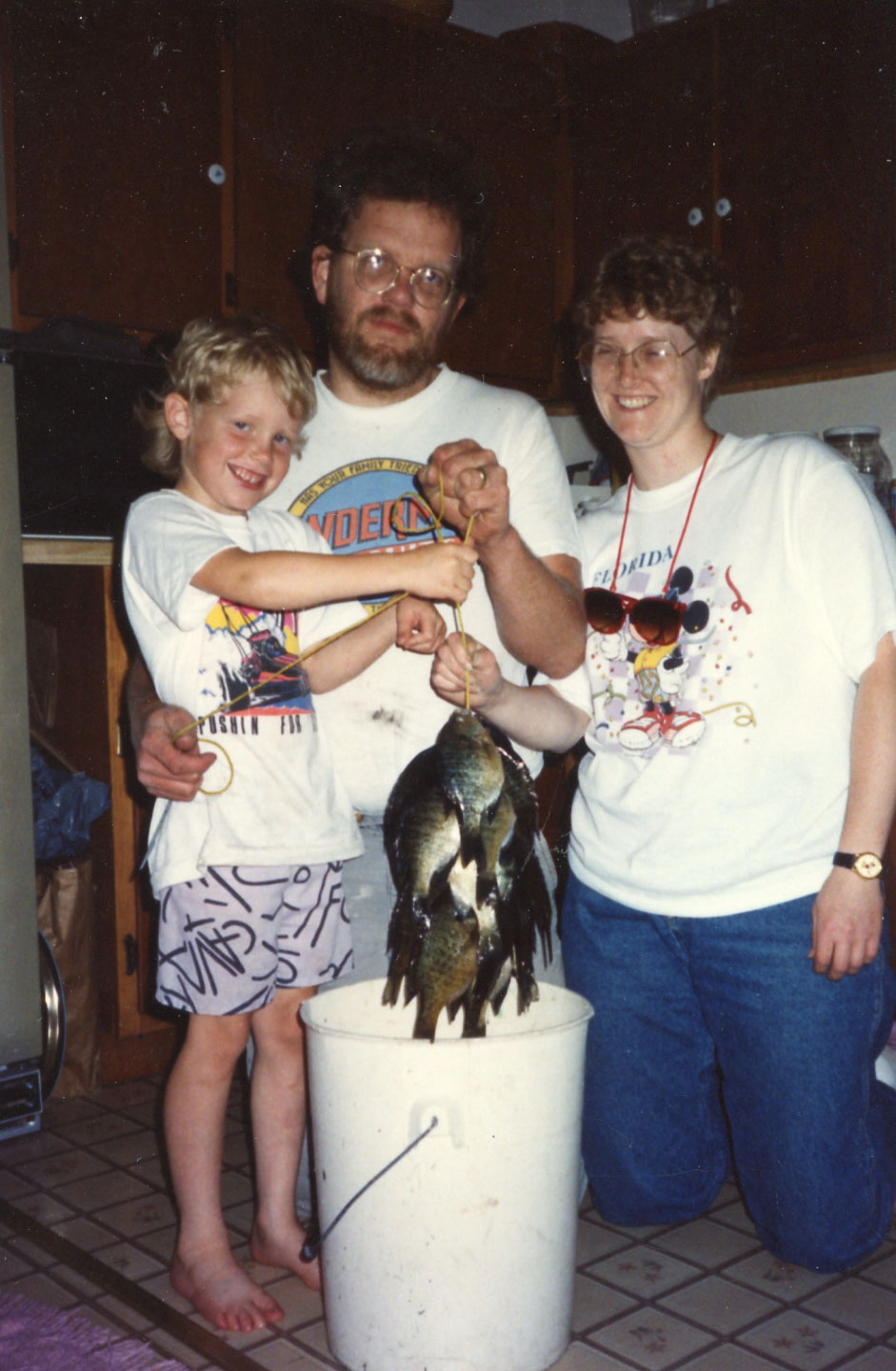
Collin and his lunker
Fishing will do that to a boy age seven.
It hadn’t been quite so easy for the 46-year-old. I spent 15 minutes getting out of bed and opening my eyes (in that order), then getting dressed and climbing up to the loft to wake Collin.
“Look at the loons,” Collin said when we stepped out of the cabin. Seven loons were paddling side by side across the middle of the lake. They looked like they were practicing for the Aquatennial Parade.
We got in the boat and headed for our hot spot, which is usually luke-warm at best. Collin asked if he could steer the boat. But it was too early for that. My eyes weren’t open all the way yet. “Later,” I promised.
I eased the 14-foot boat through a narrow channel and into a smaller lake. We drifted with the current, and started casting our jigs.
Collin caught the first keeper, a crappie about a pound in size. I put it on the stringer. Collin watched in admiration. He doesn’t like to touch fish. Then he caught a small bass. I took it off the hook for him.
I didn’t have to lecture Collin about how he had to learn to take off fish if he wanted to be a real fisherman. For one thing, my son, age 17, had ridden him pretty hard about it all week. (This is the same son who wouldn’t wake up when Collin had jumped out of bed.)
Collin and David, fishing buddies, swimming buddies, just good buddies.
And Collin knew he had to learn to take fish off. But knowing and doing are two different things. That’s what learning is all about. He had made his first small step the day before, when he borrowed my handkerchief to take off a sunfish for the first time. It was a good use for a hanky.
We left the spot after an hour and headed for another place that Collin had “heard about.” Already he is spreading gossip about where the fish are biting. That’s the sign of a true fisherman! It was a half mile away, which Collin also figured into the equation, because it gave him a chance to steer the boat. He knew I would say yes this time.
I was finally awake, and the lake was glass, so I scooted over and he took the throttle of the seven horse Mercury, and we made our way, although not in a straight line, to the next little lake.
Collin had lost his red jig, which he felt bad about, because it had caught a few fish and he thought it was lucky. “Do you have a white lure with red eyes?” Collin asked. “Uncle Mike lost a big walleye with a lure like that.”
“Yeah, it’s called a Red-Eye,” I said, taking one out and showing it to him. That was the one. I hooked it onto his leader. We started casting.
“There’s no fish in this lake,” Collin said, and not more than three seconds later, he had a strike.
Collin’s rod bent over. He reeled in steadily, with only a word of age-old advice from me: Keep your rod tip up. Is there anything finer than watching a kid reel in a nice fish?
He brought it to the side of the boat, and I lifted it in. It was a largemouth bass, about 14 inches long.
That was a lunker for the lake we were on. “Can we keep it?” he asked.
“Let’s take it back and show everybody,” I stalled.
We fished a little longer. On almost every cast, Collin said, “There’s no fish in this lake.” But that trick usually only works once.
Collin steered us back to the cabin, then jumped out of the boat with the fish almost as quickly as he had jumped out of bed. He showed his mom and dad and sister and cousin and aunt. He let everyone know how he had out-fished Uncle David. That didn’t bother me. It was a win-win situation, in today’s parlance.
We took the bass back to the lake. I had broken the news that this bass wasn’t quite big enough for a respectable fisherman to keep. I pulled out the stringer, and laid the fish in the water. I held it by the tail and pulled it back and forth, until its gills were working hard. Then we watched it swim off beneath the dock. That’s a good feeling, watching a fish swim away, to be caught another day:
I cleaned the crappie. Collin watched. It’s another fishing skill he will soon master. We ate it for breakfast. It tasted great!

Monday, July 27, 2026

If you go fishing, don’t ask why ~ July 15, 1993

 David Heiller


You never know what you’ll discover from a little girl in a fishing boat. Her name is Grace. She’s my niece and she’s four. Grace likes to fish, and I like any kid who likes to fish. So Grace and I and my two kids, Mollie and Noah, made several excursions in the boat last week.
Mollie and Noah can take off their own fish now, for the most part, so I got my hopes up. Maybe I can actually try fishing myself. Any adult who has fished with little kids knows what I mean.
But Grace brought me back to reality.
The power of a four-year-old brings reality into focus.


It started when I wanted to troll around Star Lake. Maybe catch a small northern like the one mounted on the cabin wall. Just a 12-pounder.
Trolling didn’t go over big with Grace. She was holding Mollie’s hand firmly with her left hand, and her Snoopy rod and reel in the other. Her feet couldn’t touch the bottom of the boat. She was ready to roll, and here we were, going two miles an hour while Uncle David held onto a fishing rod.
“Why we going so slow?” Grace asked. Her tone demanded an answer, and quick.
“I’m trolling.”
“What’s TRO-lling?” she asked, wrinkling her nose and holding out the word like you’d hold out a dead mouse.
I tried to explain about trolling.
“Why we trolling?” she asked next. To catch a big fish, I said.
Grace didn’t care about big fish. She cared about little sunfish, four inches maximum, that she could haul in on her Snoopy rod. She also cared about speed, and so she returned to her original question. “Why we going so slow.”
I’ve seen this logic before. Grace has discovered the one word that teaches parents patience: WHY. You might as well try to stop a glacier than battle a four-year-old armed with WHY. So I reeled in and Grace held tight to Mollie’s hand and I gunned that six horse Mercury over the lake to our hot spot.
Grace, the inquisitor, and Malika
I’d like to say that this was an isolated incident during our three days at the lake, but it wasn’t. Grace reminded me that when you take kids fishing, you usually forget about trolling and trophies. You find a hole of sunnies and spend your time taking off fish, throwing them back in the lake, and putting worms on hooks on Snoopy rods.
And you listen to questions. I can’t remember all the WHYs Grace hit me with. But three stand out.
The first came one evening at our sunfish hole. A golden retriever was running around on shore, all by itself. No owner in sight. It saw us, and swam about 50 feet out to the boat, then swam two laps around us. We had to pull out our lines.
Grace asked, “Why is that dog swimming around us?” That was the best question she asked. I sure didn’t know the answer. She could have asked next, “Why you swearing, Uncle David?” but fortunately she did not.
The second WHY came a few minutes later. A small sunfish had swallowed a hook, and was floating motionless near the boat.
“Why isn’t that dead fish swimming?” she asked. Noah, my 10-year-old son, pounced on that with a laugh. “Because it’s dead!” He thought he had won.
“Why?”
Noah sighed and didn’t answer. He had enough sense to know he’d been licked.
The third WHY came as we headed back to the cabin. Grace’s mom and dad were out in the canoe, paddling toward a group of six loons. We shut off the motor and watched. As the canoe edged closer, two loons would rear up and flap their wings and scream. They looked like a couple of King Kongs beating their chests.
I told Grace and Noah that the loons were threatening the canoe. They were trying to frighten the intruders away, I said rather profoundly.
“Why aren’t my mom and dad afraid?” Grace asked.
I tried to answer, but as usual, it fell short. I’ll let her parents try. They have more experience than me, thankfully. And hopefully more patience.

Thursday, July 9, 2026

Casting for a fishing story ~ July 3, 1997

David Heiller

If your ear lobes are intact now, guard them with your life. I taught a four year old how to cast a fishing lure.
It started innocently enough last weekend at The Cabin. When my four-year-old nephew, Collin, arrived, the first words he said to me were, “Uncle Day-vid, I caught more fish than you last year.”
He had out-fished me one evening, and he wasn’t about to let me forget it after only 12 months.
Uncle Day-vid and Collin at the cabin: fishing buddies

The next morning we went to the dock to catch sunnies. Usually with a four year old, that means dropping a line from your Sesame Street rod and reel straight down into the water, and watching half a dozen panfish converge on the worm.
They have a brief conference, then elect the smallest one to investigate further. You end up pulling in a fish only slightly bigger than the hook itself. This gives the kid a great thrill, which gives the adult a great thrill.
But Collin’s Sesame Street fishing rod and reel were broken. Why is it they only last one summer? Could it be a conspiracy?
I gave Collin my best rod and reel. I figured I wouldn’t need it. When you fish with kids, you don’t really get much fishing done yourself anyway.
Collin was thrilled to sit on the dock and catch small fish. But I couldn’t resist showing him how to cast his bobber out further, where the bigger fish might be.
Learning to cast a fishing rod is a milestone in a child’s life, like riding a bike or hitting a baseball. One of my earliest memories is of fishing with my brother, Glenn, and trying to cast with a rod and reel.
Glenn must have been in a good mood that evening to let me use it. Usually it was Cane Poles Only.
The open-faced reel had a thick black line. You used your thumb for a drag. It was virtually impossible to cast without getting a backlash the size of an eagle’s nest.
I think I made one cast, then spent the rest of the evening trying to untangle the line. Glenn was not pleased, to put it mildly. But I was thrilled to have been given the chance to actually cast my bait. I eventually mastered the reel, and was able to cast it at least five feet.
Getting the bait on is the step before casting.
With that rite of passage in the back of my mind, I showed Collin how to cast. I showed him how the line-release button worked. I showed him how much line should be dangling at the tip of the rod when you cast.
I told him how to bring the rod back to two o’clock, then bring it forward to 10 o’clock. I don’t know if he knows how to tell time, but he nodded dutifully. I held his hand and we did it together. The bobber soared out at least five feet.
No fish was hooked, but Collin was. He couldn’t believe he had done that. He grabbed the rod from me. “I want to do it now, Uncle Day-vid,” he said.
“Let me show you one more time,” I said. But we both knew that wasn’t necessary. He kept the rod and kept casting.
Most of the time he looked like a mule skinner whipping a team of horses. He churned up the water with short casts. Once in a while he’d get one out 20 feet.
Fishing pretty much stopped for Collin at that point and casting took over. He would simply cast and reel, cast and reel. He paused only long enough to have me bait the hook after a fish had caught up to it long enough to strip it bare.
On Saturday night, I took Collin and two adults out in the 14-foot fishing boat. I sat in the rear, manning the six-horse Mercury and keeping a close eye on Collin.
Watching a kid cast on a dock is one thing.
You can give him a wide berth. Sitting next to him in a boat is another. There’s no place to hide.
Collin worked both sides of the boat. He cast to the front and to the back. He would announce his direction with a polite sentence. “Excuse me, Day-vid.” “Excuse me, Nancy.” “Excuse me, Mike.”
We wanted to excuse him into the lake. But instead we just hunched our shoulders and lowered our heads and waited for the bobber to go whipping past.
Collin was sitting on a boat cushion. Each time he cast, it inched off the seat. Finally after one mighty cast he ended up with a crash in the bottom of the boat.
No, I didn’t hope he had a broken arm. But I couldn’t help telling him that that’s what happens when you cast so much. “You need to let your bobber sit for a while,” I told him for the umpteenth time.
But Casting Collin wasn’t going to let a bruise or two stop him. He kept on casting, and we kept on ducking.
I know I could have made him stop and sit still and be quiet. But fishing is supposed to be fun, and Collin was having fun. So I let him cast away.
I ended up catching three keepers to his one. “I caught more fish than you,” I said with a smile that he recognized. “Maybe that’s because you did too much casting.” He didn’t say anything. It was a four-year-old dilemma.
We got back at dark. Collin held a flashlight while I cleaned the fish. We ate them the next day. There’s nothing better than fried sunfish fillets, rolled in flour, fried in butter, and seasoned with salt, pepper—patience!
Time will tell where Collin goes, fishing-wise. I tried to teach him how to put on a worm and take off a fish. He didn’t want learn that mundane skill quite as eagerly. But I’ve got a hunch he will.
Once you learn how to cast, the rest is all downhill.

Saturday, June 27, 2026

Some fish never stop growing ~ July 6, 1989

David Heiller

We did a lot of fishing when I was a kid, growing up on the Mississippi River in southeastern Minnesota. I have a thousand memories, but one stands out. It’s so old, I only remember remembering it, if you know what I mean.
It was a summer evening, when I was about six. We were fishing off a dock south of Brownsville, in the backwater. The dock was full of us kids. I had a cane pole, of course, and stood at the edge of the black water, which lapped over the old wooden planks and onto our feet. It was that still time of day, with the warm smell of summer evening in the air, a smell kids know, a mixture of fish and water and wet wood and mayflies and warm sunshine.
I remember that smell, and I remember my cane pole just about jumped out of my hand as a fish took the huge bobber under. I pulled up, the black line straining, and suddenly a huge bass lay thrashing on the dock. It shook out the hook, and started flopping toward the water. Glenn, my older brother, stood and gawked for a split second. Then he pounced on the fish like a cat, and clutched it in 15-year-old hands, a lunker large mouth.
It seemed like a lunker to me, anyway. We measured it at 16 inches on the spot. By the time we got home, it was 18 inches long. That’s all the longer Glenn would allow it to grow, and it has stayed there for 29 years. I admired that black bass for years. I used to hold my hands apart 18 inches, and tell myself, “That’s how long it was.” I could see its green back, the black line running down the side, the huge mouth, the red in its eye. It’s been my favorite fish ever since.
Noah's bass
This past weekend, we took a family vacation to a cabin on Pelican Lake, near Orr, Minnesota. As soon as we had unpacked the car, we piled into the boat, and headed for a fishing hole, my son, Noah, my sister-in-law, Nancy, and me.
We pulled up at a narrow channel between two small islands. It looked like a good spot, according to the resort map. “Reef,” it said, showing tiny lines in a circle. Besides, another boat was here too. They must know what they were doing, I thought. That’s a basic rule of fishing: If you don’t know what you’re doing, find someone who looks like they do. One of the guys from their boat was in the water, tugging at the anchor rope. “Anchor’s stuck on the rocks,” he called out as we pulled up 30 feet away.
Noah cast a nightcrawler out from his Mickey Mouse rod and reel, while I bent down to bait my hook. Suddenly there was a splashing. Noah yelled, “I’ve got one, I’ve got one.” His rod, all three feet of it, was doubled over the side of the boat out of sight. It pulled him to his feet.
“Pull it in,” I said, thinking it was a sunny. Then I saw the swirl of a large green back in the water. I gawked for a split second. “Help him, Nancy,” I called. She reached out, grabbed his line, and hoisted the fish into the boat.
“Look at that, Dad,” Noah said. He held up a largemouth bass, about 16 inches in length. It must have weighed a pound and a half, maybe a little more.
Good fishing for Noah, David, and Nancy.
“Nice bass,” the guy in the water called from the nearby boat. It was an honest compliment, but did I detect a touch of jealousy, a wistful tone in his voice? Where had I heard that before? From my brother on the dock south of Brownsville 29 years ago?
The fishing peaked then and there. We caught plenty of sunnies the next two days, plus perch and crappies and smallmouth and rock bass and a two pound northern. But no more largemouth bass like that.
Which was fine with Noah. Because the largemouth began to grow almost as soon as it was filleted and refrigerated. “How big was it, Dad?” he asked that evening as we returned to the hot spot. He held his hands maybe two feet apart. “That big?”
“No, not quite,” I answered, trying not to smile.
“That big?” He moved his hands 18 inches palm-to-palm, but they immediately drifted apart, like opposite poles on a magnet, and the fish grew some more.
“Yeah, I guess so,” I said, smiling.
And for a split second, I smelled it again, that smell of fish and water and wet wood and mayflies and warm sunshine.

Monday, May 11, 2026

The one that got away on Walter Lake ~ May 22, 1997


David Heiller

Paul, Dave, Jim and I had a chilly five days in the Boundary Waters last week. It froze most of the nights, and snowed most of the days.
But we didn’t mind, because the fish were biting.
Jim caught the first one a few hours after we set up camp on the Walter Lake. It was a 27-inch lake trout. We figured its weight, using a DNR formula, at 13 pounds.
Jim and a northern in the snow.
Later that afternoon, Paul landed a 42-inch northern. It weighed 21 pounds. The next day it was Jim with a 39-inch northern and Paul with a 38-inch one, 17 and 16 pounds respectively. Then Dave pulled in a 30-inch, eight pound northern.
It’s funny how a person can put up with crummy weather when he is catching fish like that.
Well, technically, I didn’t catch a fish like that. I caught a few smaller ones that fit nicely into the frying pan. It’s all luck anyway, right?
The fish I’ll remember most is the one that got away.
It took my cisco and bobber and ran with incredible power toward the shore of the bay where we were camped. Then it veered left, toward the center of the bay.
It stopped for a few seconds to swallow the cisco. Then it started swimming again. That’s when I set the hook. Wow. It was the biggest fish I ever felt. It was almost scary, thinking what was at the end of my line.
I started reeling in. The fish and my line went back toward shore. Then it stopped. I couldn’t budge the fish.
With a sickening feeling, I realized the fish was snagged on something. Paul came over with a canoe. I hopped in the front, and we paddled to the spot. He saw a flash of the fish amidst the branches of a dead tree under the water. The fish had taken a side trip through the snag when it ran with my minnow, and was now wrapped around a branch.
I gave one more tug, the line broke, and the big fish was gone.
How big was it? A 25-pounder, at least.
I moped about the lost fish a time or two. Dave tried to console me. “It’s just a fish. It’s just life,” he said in the canoe later that day. I knew he was right. But I couldn’t help feeling sad. I couldn’t help wondering how big that fish was. Thirty pounds, easy.
I lamented the loss the next night around the campfire. Dave said, “Well, at least you can beat it in cribbage.” We all laughed, and that was the last I mentioned it. No use crying over lost lunkers.
FISHING WAS only part of our trip’s highlights. We saw a cow moose and her calf one morning. The calf was sucking milk, while the mother eyed us warily from behind white cedar branches.
Seeing a mamma and baby moose in the wild is worth at least one big fish. It’s always amazing how big they are. The cow was six feet high at her hips.
ONE afternoon two forest service employees came across the lake and checked our latrine to see if a new one would have to be dug. They were clearing portages, using axes and saws.
We were glad they followed us in. It made the trip out much easier. On the trip in, we had to climb over several trees that had blown over the portages. That’s not easy to do with a pack and canoe on your shoulders.
The rangers were both young women, fresh out of Northland College. We told them about some of our past 11 trips together. They listened politely. That impressed me. It’s nice when people know how to listen. We felt like old-timers compared to them. But they looked very competent, and no doubt they were.
“They pay you to do this job?” Jim asked them. That summed up our feelings as they paddled off to the next campsite.
ANOTHER memory: We were crossing the first portage on our way to Walter Lake. Paul was walking ahead of me. He was carrying two packs, one in front and one in back; three paddles, two life jackets, and a minnow bucket. We pride ourselves on making portages in one trip, and Paul wasn’t going to break that tradition.
Paul is not a small man. He says he weighs 300 pounds. As my daughter would say, “Yeah right, Dad.”
Paul, on an easier portage,
during a different year's trip.
We came to a spot on the portage where water from snow melt was rushing across. A half-rotten log lay on one side of the trail. Paul didn’t want to get his feet wet, so he tried walking across the log. The log cracked and sagged. Paul jolted from one side and the other, like a cement truck on a high wire. He couldn’t see his feet because of the pack in front.
We stood and watched and tried very, very hard not to laugh, the way you do when you see someone slip on a patch of ice.
As usual, Paul made it across. He always does. He is surprisingly nimble for a mountain. A few well chosen words always seem to help him. He provided a humorous moment for the rest of us insensitive louts.
The four of us plan on returning to our fishing hot spot again next year. I want to take another stab at that 35-pounder that I lost.
By the way, Walter Lake isn’t the real name of the lake. If I mentioned the real name, I might not live long enough to return there with my three fine friends.

Tuesday, May 5, 2026

It was raining cats and dogs and ‘crawlers ~ May 3, 2006


David Heiller

For the first few days my eye hurt, and the vision was cloudy. It was like looking through a dirty window.
But now, wow.
It’s hard to convey what is happening.
I woke up the other morning and looked out the window and saw a squirrel on a tree branch outside the window. Without putting my glasses on. That hasn’t happened since we bought this house in 1981.
This was probably a good nightcrawler day,
but not maybe the best nightcrawler spot.
So at 6:30 a.m., when the darkness left the sky enough for me to see the ground well, I slipped on a cap and jacket and headed out. A light rain was still falling, and I knew I would get soaked, but that was just fine on a Sunday morning. No rush to get to work, no deadlines. Just a walk down the road.
And it was a good one. The driveway and township road were covered with worms. You couldn’t lay down without touching one. Not that I tried thatI don’t like them that much. But they were everywhere.
Not all the worms were full-grown, mind you. That would he asking too much. But every couple minutes, sometimes more often, I would spy a huge, healthy crawler.
Walking down the road on a Sunday morning, no traffic, serenaded by a cardinal, that’s getting close to heaven for me.
If you aren’t a fisherman, you maybe puzzled by this. What’s the big deal? Well, last summer a dozen crawlers cost $2.25, so there’s the practical side of things.
There’s another thing too though. Getting your own bait, beating the system, is fun. It adds to the adventure, and the fish seem to taste better with home-grown nightcrawlers.
Gathering nightcrawlers was a big part of my youth. We didn’t seem to get nightcrawler rains back then, at least that I was aware of. We did it the old fashioned way, with a flashlight at night in the backyards of Brownsville.
It wasn’t easy. My brother, Danny, and I would take the one flashlight that Mom owned. The batteries always seemed about half dead too. We would go into the backyard, walking as quietly as possible, then we’d carefully shine the light on the grass. The trick was to not shine the light directly on the crawler, because that would send it collapsing back into its hole. If that happened, you had to make a quick reach to get it before it disappeared. Sometimes we would get a good hold, and carefully tug it out. That took some finesse, because you didn’t want to break it or squeeze too hard and damage it.
Our yard was always pretty good pickings, but it wasn’t enough, so Danny and I would venture through the town. First we’d go to Burfields next door. We had to be careful though, because they had a houseful of fishermen too, and Billy protected his turf like a Doberman. There was a sink hole below their house where they would throw the kitchen waste, and it was full of worms and crawlers, but Billy did everything short of erecting a guard tower and 50 caliber machine gun to keep us out of that prime spot.
Everett Nelson’s garden was also a ‘crawler haven, but we had to be desperate to venture there. He seemed to have a sixth sense of when the crawlers and the little boys would be out. He always seemed to be looking out his window on the south side of the house on the best nightcrawler nights. We’d hear a yell from him and scramble off to another spot.
But there were plenty of good spots and friendly yards. Mrs. Bulman’s. The Collerans. Hansens. Bill Miller’s. Brownsville seemed to have a lot more open territory then.
One night I gathered such a windfall that I counted out 100 crawlers and took them to Serres’ Marina the next morning. Uncle Joe gave me a penny a piece for them. He sold nightcrawlers at his bait store at the marina for 25 cents a dozen, I recall. I don’t know if Joe really needed them or if he was just doing his good deed.
Last Sunday wasn’t quite that good: I picked up 80 in just under an hour. Still it was a lot of fun. Putting them to use will be even better.

Sunday, March 29, 2026

Some pleasure and pain and serious fishing ~ March 1, 2001


David Heiller

Tom declared war on the trout at about 11:30 Sunday morning, February 18. We were camped on an island on Thomas Lake, 12 miles into the boundary waters. We had caught only two trout since pulling in the day before, and that just wasn’t cutting it for Tom.
“It’s time to get serious about fishing, I’ll tell you that,” he said as he toasted a bagel with jam over the campfire. Tom was always toasting something good.
Tom doing some serious ice chopping.

“I thought we were serious,” I said. We had four lines in the water at various depths, in a tried and true spot—one that Tom picked out, I might add. We checked the flags on the tip-ups every few minutes. We chopped open the frozen holes every half hour or so. That’s not serious?
“That’s not serious,” Tom replied, as if he could read my mind. “I mean serious. We’re going to go after them. Drill new holes. Move around. Start jigging.”
I felt like doing 20 push-ups on the spot.
Tom stalked onto the ice to check the tip-ups. I stayed by the fire. There is nothing as cheerful as a fire on a winter camping trip. The wind on the lake was downright raw. Back home the radio was probably talking about “dangerous wind-chills.” We didn’t need a radio announcer to tell us that.
Ten minutes later Tom was back. Nothing. He slumped down by the fire—he was toasting banana bread by this time. I decided I’d better get serious too, so I took a look at the flags through my binoculars. No need to venture too far from the fire.
Then I got to say the words that every ice fisherman longs to hear: “You’ve got a flag up.” Tom sprinted past me before my words were blown away on that howling wind. I grabbed my camera and followed.
By the time I caught up, he had chopped his hole free and was pulling up line. At first there was nothing.
Then Tom gave a yank. “He’s got it!” he said, pulling in more in line.
Tom stopped and said, “He’s gone.” He pulled up more line, hand over hand.
David and the pretty trout.

“He’s on again!” Tom said. He pulled and pulled, 70 feet of line and more. Then he reached into the hole and lifted out a trout. It was a beauty, 27 inches long. Very dark, almost black, with red at the tips of its fins. A good eight pounds.
That trout was the exclamation point of our winter camping trip last week. It was a pleasure to see, and there is a lot of pleasure in winter camping. There’s a lot of pain too.
The pain is as obvious as numb fingers and frozen toes. Or try getting out of your sleeping bag in the middle of the night to go to the bath-room when the temperature is pushing 30 below zero. Need I say more?
It’s a lot of work, skiing 12 miles, drilling holes for fishing, gathering and cutting firewood, and trying to stay warm when your hands are dipped in ice water.
The pleasure is more subtle. It is partly tied to the beauty of the wilderness. Like when we hit Thomas Lake on Saturday afternoon. We came across a torn up piece of ground that was littered with the bones of a moose. A pack of wolves had devoured it there. We found the skull and spine and hooves and other bones. Patches of melted snow on the grass marked spots where the wolves had slept. The ground was covered with their tracks and scat, and with the tracks of ravens that had cleaned up after them. It wasn’t a disturbing sight. It made me think that things were in balance there. Darwin’s theory lay right before our eyes.
The beauty really shined when we skied out on Monday morning. The temperature had risen about 40 degrees, to about 20 above zero. Our trail followed a creek that meandered through beaver ponds and hidden lakes for many miles. In the summer this area would have been impassable, a bug-infested swamp. But last week it was a crown jewel.
We had to work hard to see it, pulling a heavy sled through sub-zero temperatures. But seeing that land unfold like a field of diamonds made it worthwhile. It lifted my spirits and made me thankful to be a part of this land.
I was proud of it, and proud of myself for being able to do what I did. Some people look at me like I’m crazy when I go winter camping. And there are times when I feel a bit crazy while I’m doing it. It would be a lot easier to stay home.
But the rewards are there, especially with a good friend like Tom Deering, who is as smart and tough as they come. Besides being a serious fisherman.

Wednesday, March 4, 2026

A great trip, despite the one that got away ~ March 7, 2001


David Heiller


Tom pointed out the bare hills bordering Moose Lake shortly after we started skiing down it on Saturday, February 23. They looked black and stony, as if a fire had burned them, but the deforestation actually came from a wind storm.
The real magnitude of that famous July 4, 1999 storm hit us a little later, as we skied on a portage into Rice Lake. Three years ago, the portage was right out of a Boundary Waters postcard. Big, beautiful birches and poplars lined the ski trail.
But not now. About 90 percent of the trees were on the ground, or snapped off at right angles 15 feet above the ground. They all lay in the same direction, as if a volcano had erupted to the west.
David cooking on Little Puffer.

“Look at all the new growth,” Tom said when we stopped in the midst of the mess. He was right; you couldn’t put your arm out without hitting a small tree. Fickle old Mother Nature was fast at work, undoing the damage she had wrought.
And once we got to Basswood Lake, the storm damage was gone. That was amazing too. How could the wind mow down a whole forest like a scythe, and not touch a tree a mile away? Those are the kinds of questions that winter ski trips bring out.
Once we hit the bay on Basswood, we drilled holes and started fishing. This spot had yielded some big northerns in the past, and both Tom and I expected no less this time.
Then we pitched our tent on an island. Several huge white pines still stood there untouched. They seemed like stout old friends to me. Tom figured they were a couple hundred years old. It was good to see them standing, although Tom noted that they were in poor health and would probably fall down soon. Science teachers notice things like that.
Tom put Little Puffer in the middle of the tent. Little Puffer is a stove that he made out of an old gas can, and it is a testimony to the importance of a stove in winter camping that it is given a name.
We cut firewood and watched for the flags on our tip-ups to spring into action. Not more than an hour later, I had the first northern on the ice, a four-pounder. Then Tom pulled in two more, a couple pounds bigger than mine. They were dark and fat. “You just don’t see northerns like that back home,” Tom marveled.
As darkness fell, a west wind whipped across the bay. We foolishly ate our supper outside by the campfire. It was cold! But that changed after we crawled into the tent and lit Little Puffer. “What took you so long?” the stove almost seemed to say as Tom struck a match to the birch bark and twigs inside it. In just a few minutes we were sitting on our sleeping pads and starting to shed our layers of clothing.
We lit two candle lanterns and hung them from the center pole. They cast a golden light. Our pads were on benches of snow that conformed to our bodies better than the most expensive mattress. We talked and read. Then I started dozing off. It was getting late. I looked at my watch: 7:30 p.m.
If there is a better recipe for sleep, I would like to find it: a cozy tent, a warm sleeping bag. The sound of the wind blowing through the friendly pines. A body that is tired from a seven-mile ski.
Skiing till your head is clear.

We were both asleep by nine. I can’t remember the last time I slept that well.
The fish of the weekend hit Tom’s tip-up the next morning. He set the hook, and the fish didn’t give. It was like the cliché that fisherman say: “I thought it was a snag,” although Tom to his credit didn’t say that, because snags don’t tear line off a reel like this one did. Then it shook its head and the line sliced into Tom’s little finger, and it was gone. Tom pulled in the line with a mixed grin of disappointment and admiration.
We will never know how big it was. That’s kind of fun to think about. Basswood Lake holds the state record for northern pike, 45 pounds, 10 ounces. Maybe this one was its grandson.
And that was the peak of the fishing for us. That happens sometimes. After that, the fish quit biting. They would take a line and run with the bait, then drop it. When it came time to set the hook, there would be nothing to set. The storm system that was dumping a foot of snow on Pine County was sending its signals all the way to the Canadian border, telling those big dumb northerns not to eat any more smelt.
On Sunday afternoon, I took a day trip and skied into Canada for several miles. I didn’t see another person, or any animals. But it was still a fantastic time. The songs that were rattling around in my head finally quieted down. That’s when I know I’ve reached some inner peace, when my brain is empty, and I can just think about the wind and the lake and my skis gliding effortlessly over the snow like I could have skied forever, just kept going.
“Did you catch any fish?” I asked Tom when I got back to camp later that afternoon.
Hanging up stuff.

“Look by the fire,” he said with a poker players grin.
I walked over and saw five nice northerns on the snow. Tom let me babble on for a bit, he told me that they were the fish we had caught earlier. He had had to move them because a mink had discovered them and was trying to eat them. Tom said he had to chase the animal away three times.
That night, before we went to bed, we hung the fish in a pack from a tree, to make sure the mink wouldn’t return.
We skied back on Monday, after a morning of fruitless fishing. The seven mile ski back home seemed easy. Just before we reached the landing on Moose Lake, two dog teams sped past us. They were cruising. What a beautiful sight. They moved with such ease and joy, and each musher gave us a wave as they rode past. The sight will stick with me for a long time, a carefree memory from a successful winter camping trip with the big fish that got away.